



GI Map Test + Fecal Gluten Peptide
GI Map Test + Fecal Gluten Peptide
Couldn't load pickup availability
DESCRIPTION
The restaurant promised gluten-free dishes. Your stomach says otherwise. Only one of them can actually be right
The new generation GI-MAP + Fecal Gluten Peptide measures what your gut already knows: the actual molecular trace of gluten in the last 2–4 days, alongside a complete map of your microbiome, from a single stool sample collected at home.
Here's the part nobody warns you about when you go gluten-free.
You read every label. You ask the server twice. You bring your own snacks to the office party. You skip the wedding cake. And six months in, your gut is still running the same script — the bloating, the fog, the unpredictable mornings, the dinner you left early.
So you start asking the only question that's left: am I doing this wrong, or is something else going on?
This test was built for that exact question. One stool sample. Two answers. Let's take them in order.
What the GI-MAP actually is
The GI-MAP is a stool test that looks at the DNA of the organisms living in your gut. Not their leftovers. Not their proteins. Their actual genetic code.
That sounds like a small distinction. It isn't. It's the whole game.
Older stool tests rely on culturing — growing organisms in a dish to count them. The problem is that most of the organisms in your gut don't grow well in a dish. They evolved to live in a low-oxygen, body-temperature, nutrient-rich environment. Stick them on a petri dish and most of them die quietly without leaving a trace. Which means older stool tests systematically miss most of what's actually living in you.
The GI-MAP doesn't culture anything. It uses qPCR — quantitative polymerase chain reaction — to find each organism's unique DNA signature and count exactly how much of it is there. qPCR is the same technology used in research labs to track viral load, identify bacterial outbreaks, and confirm pathogens in clinical samples. It's accurate, reproducible, and — most importantly — quantitative.
Quantitative is the word that does the heavy lifting. The report doesn't just say "Klebsiella present." It tells you how much Klebsiella, against a reference range. Numbers can be compared. Numbers can be tracked over time. Numbers tell your practitioner which patterns deserve attention now and which can wait.
What the report actually shows you
Sixty-five markers across nine categories, every one of them quantified:
Bacterial pathogens (12 markers). The big-name organisms most people think of when they hear "stool test." Things like Salmonella, Shigella, the toxic strains of E. coli, C. difficile and its toxins, Campylobacter, Yersinia. If any of these are showing up in measurable quantities, your practitioner needs to know — and so do you.
Viral pathogens (4 markers). Norovirus GI and GII, Adenovirus 40/41, Rotavirus A. Most stool tests skip viruses entirely. The GI-MAP catches them.
Parasitic pathogens (3 markers). Cryptosporidium, Entamoeba histolytica, Giardia. The classic gut parasites that food diaries and elimination protocols have no way of catching.
H. pylori — and its virulence factors (3 markers). Helicobacter pylori is a bacterium that lives in the stomach and upper GI tract of a huge percentage of the population. Most of the time it's silent. Sometimes it's not. The GI-MAP doesn't just tell you whether H. pylori is present — it tests for cagA and vacA, the two virulence factors that distinguish the strains worth paying attention to from the ones that probably aren't doing much. That's the kind of nuance older tests can't give you.
Normal gut bacteria (9 markers). This is where most tests fall apart. The GI-MAP measures the good guys — Bacteroides fragilis, Bifidobacterium, Lactobacillus, Akkermansia muciniphila, Faecalibacterium prausnitzii, Roseburia, and others. Why does this matter? Because telling you what's wrong is half the picture. The other half is whether the beneficial half of your microbiome is still showing up to do its job. If your Akkermansia is low, that's information. If your Faecalibacterium is in the basement, that's information. You can't build a smart plan without it.
Opportunistic bacteria. Citrobacter, Klebsiella, Proteus, Pseudomonas, Staphylococcus, Streptococcus, Methanobacteriaceae, Morganella, and others. These aren't classic pathogens — they're organisms that live quietly in healthy guts and start acting up when the microbial balance shifts. The "opportunistic" panel is also where some of the markers most associated with autoimmune patterning live. This is the part of the report your practitioner will spend the most time on.
Fungi and yeast. Candida albicans, other Candida species, Geotrichum, Microsporidia, Rhodotorula. If you've spent any time on the gut-health internet, you know that "candida" gets thrown around carelessly. The GI-MAP gives you an actual measurement instead of a guess.
Intestinal health markers. This is the section most practitioners flip to first:
- Calprotectin — an inflammation marker. When it's elevated, the gut lining is inflamed.
- Secretory IgA (sIgA) — your gut's first line of immune defense. High and low both tell a story.
- Anti-gliadin IgA — an immune response to gluten in the gut.
- Elastase-1 — a measure of pancreatic enzyme output. Low elastase means food isn't getting broken down properly upstream.
- Steatocrit — fat in the stool. A marker of malabsorption.
- Beta-glucuronidase — a marker linked to hormone recycling and detoxification.
- Occult blood — hidden blood in the stool.
These seven markers turn the GI-MAP from a microbiome map into something much more useful: a picture of how the whole digestive system is functioning, not just who lives in it.
Antibiotic resistance genes. A targeted panel of resistance markers across major antibiotic classes. If antibiotic decisions are on the table — for H. pylori, for an opportunistic bacterial overgrowth, for anything — knowing which resistance genes are already present in your gut is the difference between a smart decision and a wasted course.
And then the new generation marker: the Fecal Gluten Peptide
Here's where the new generation panel earns its name. The Fecal Gluten Peptide assay measures the 33-mer gliadin peptide directly in your stool.
The 33-mer is the specific fragment of gluten that resists human digestion. Your enzymes can't fully break it down. So if you ate gluten in the last two to four days — even a hidden trace, even from a contaminated kitchen, even from the "gluten-free" oats that got milled on a shared line — that 33-mer fragment makes it through your digestive tract and ends up in your stool. The assay sees it.
No food diary. No memory test. No "I think I was careful at brunch." Just a direct molecular reading of whether gluten reached you.
That 2–4 day window is the whole point. Long enough to catch hidden exposure from a weekend out. Short enough to be actually useful. It's the difference between wondering and knowing.
Bottom line
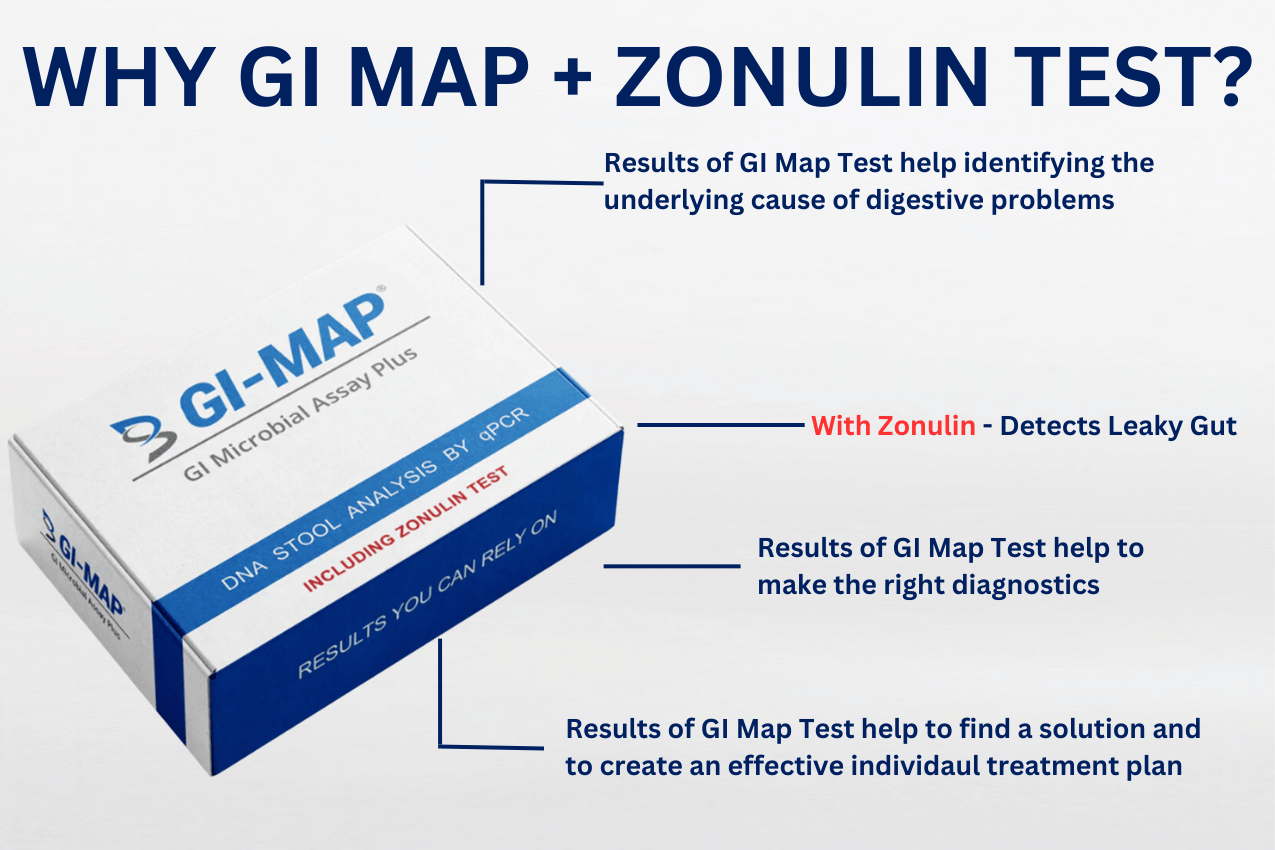
One stool sample. 66 markers. The full GI-MAP plus the new Fecal Gluten Peptide layer. A consolidated written report your practitioner can read clinically — and, if you want it, an expert review video walking you through what's in it.
"Another great company that does biome analysis is called GI Map." — Tony Robbins, Life Force (Instant #1 New York Times Bestseller)
THIS TEST IS FOR YOU, IF
You Already Know Your Own Story. This Is For The Moments In It.
The wedding. The work trip. The dinner with the in-laws. The week you swore was clean.
- You manage celiac disease or gluten sensitivity, and you've stopped trusting menus
- You've been gluten-free for months and your symptoms still come without warning
- You travel for work and need to know whether your hotel breakfasts are quietly costing you
- You share a kitchen with people who eat gluten and you've wondered about the toaster, the cutting board, the wooden spoon, the colander, the butter dish
- You've cancelled plans, left dinners early, or quietly avoided situations without wanting to explain why
- You're tired of the friend who says "a little won't hurt," and the part of you that wishes they were right
- You've spent years collecting opinions and you'd like, finally, to collect a number
- You want one piece of evidence that settles the argument with yourself
YOUR ADVANTAGES
What This Test Gives Back To You.
Not promises. Information.
Knowing. The 33-mer gliadin peptide, measured directly in stool. The molecular trace of gluten exposure in the last 2–4 days. Yes or no. Not "I think I was careful."
Depth. Sixty-five microbiome markers, quantified by qPCR DNA technology. Bacterial pathogens, viruses, parasites, fungi, opportunistic organisms, and inflammation markers — reported as numbers, not labels.
Simplicity. One sample. One shipment. One consolidated report. The microbiome question and the gluten question, answered together.
Privacy. Collected at home. On your schedule. No clinic. No waiting room. No conversations you didn't want to have.
Speed. Samples are processed on arrival. Results are typically returned within 5–10 business days.
A report your practitioner can read. Structured for clinical interpretation. An optional expert review video with an IFDW practitioner is available at checkout.
HOW IT WORKS
Three Steps. About Five Minutes Of Your Time. Then The Lab Does The Heavy Lifting.
From kit to report in roughly 10 - 15 business days.
- Order the kit. It ships to your door with everything you need and clear instructions.
- Collect at home, on your own schedule. A single stool sample, sealed and ready for return shipping in the prepaid mailer.
- Mail it back. The lab runs the GI-MAP qPCR panel and the Fecal Gluten Peptide assay on the same sample.
- Receive your report. Microbiome markers, inflammation markers, and recent gluten exposure — all in one document — ready to walk through with your practitioner.
TEST KIT INCLUDES
Everything You Need In One Box.
No extra trips. No extra purchases.
- Stool collection kit with all required materials
- Step-by-step illustrated collection instructions
- Prepaid return shipping label
- Lab processing of the full GI-MAP panel via qPCR
- Lab processing of the Fecal Gluten Peptide (33-mer gliadin) marker
- Comprehensive results report covering microbiome, inflammation, and recent gluten exposure
- The option to walk through your results with an IFDW practitioner
This test is not a replacement for medical care. Always consult your healthcare provider for diagnosis and treatment.
- In Stock. Ships within 2-3 days.
- US Made - Tests conducted by US Labs
- Results within 10 to 15 business days
- Fast (2-3 days) & Free shipping and prepaid return shipping included




We are here to help
FAQ - Answers To Your Questions
What is GI Map testing?
GI Map (Gastrointestinal Microbial Assay Plus) analysis focuses on the genetic material of microorganisms in the gastrointestinal tract.
GI Map Testing is an advanced clinical evaluation that is considered as a state of the art for characterization of gut microbial population metabolism.
This test gives an impression of the overall gut microbiota not only of the bacteria but also of the parasites, viruses, and funguses present with several indicators related to the gut health status and functions.
Who can benefit from GI Map testing?
GI Map testing can be used by anyone that has gastrointestinal complaints, autoimmune disease, inflammatory bowel disease IBD, or anyone who aims to push their overall health into high performance.
How is the GI Map test conducted?
Stool material from the client is collected as the test sample for the test. The specimen is however taken and forwarded for processing by an expert in a laboratory.
The output describes how many of each species of gut microorganism are present.
What are the sample collection requirements?
All our collection kits come with clear and concise instructions.
Why Is quantification using qPCR Technology so important?
qPCR offers a much more accurate and reliable result. This allows experts to study and determine the clinical significance of the microorganisms far more than the use of standard PCR, culturing, microscopy or sequencing approaches.
In practical terms, there is a need for a practitioner to find out just how many pathogenic organisms or pathogenic dysbiosis patterns are contained within the stool sample of the client being diagnosed.
How do I interpret the GI Map Microbiome Stool Test Results?
We recommend you discuss your quantitative results with an IFDW Expert for a comprehensive stool analysis.
What are the specimen requirements, and do I need to prepare fast?
What to do: Single Stool Sample – Ambient room temperature in specimen vial provided.
And there is no need to prepare or fast before testing.
What does dl signify on the GI-MAP Report mean?
< dl indicates "less than the detectable limit."
Do I need to stop taking any of my medications before I Collect My GI-MAP sample?
No. Please continue taking all medications unless otherwise directed by your provider.
These instructions may vary by provider so you may want to check with your provider. They may also have dietary restrictions as well depending on the testing.
Is the Client responsible for postage?
No, collection kits include a pre-paid 2 business day FedEx return label if mailed within the U.S.
Can I drop off my Collection Kit at a local FedEx office?
Yes, please follow the packing and shipping instructions provided with the collection kit.
Your tracking number can be found on the Return Label. Please keep this tracking number for sample tracking purposes.
The postage-paid envelope can be dropped off at any Fed Ex Drop Box, but ensure that the drop box is cleared within the same day or the next day. We only require that the specimen be received within 10 days after collection.
How accurate is GI Map testing?
Experts in the field rate the GI Map testing as very accurate and dependable. It employs improved molecular diagnostic procedures to detect the presence of microorganisms within the gastrointestinal tract, hence an effective improvement on traditional diagnosis.
How often should GI Map testing be repeated?
The number of tests done is wholly dependent on health status and specific problems that are being solved.
After an intervention is done, for example, gastrointestinal practitioners may suggest follow-up tests to determine how effective the intervention was and look at changes that have happened over time with the gut microflora.
Protocols are typically followed for 3 months and retesting is done between 2-4 weeks after the protocol has been completed.
How long does it take to get my results?
After sending (FEDEX) your sample, give it 3-5 business days for the specimen to arrive at the lab. Results will be released roughly within 7 to 10 working days although on some odd occasions it may take three weeks.
How do I get my GI MAP test results?
When test results are ready they’ll be available to you in your client account at https://ifdw.org/pages/login-client-portal. You need to activate your account in order to view these results.
Right after the test was ordered, a letter with an invitation for account activation should have been sent to your email address.
Please check your inbox and also look in your spam folder if you haven’t seen the email yet.
Can I have someone do a review or consultation of my GI Map test results with me?
Yes. You can purchase the GI Map and request a Result Consultation.
Just choose the “With Result Consultation” option above when making the purchase.
We highly recommend talking to an IFDW Expert about your results as they are quite difficult to interpret.